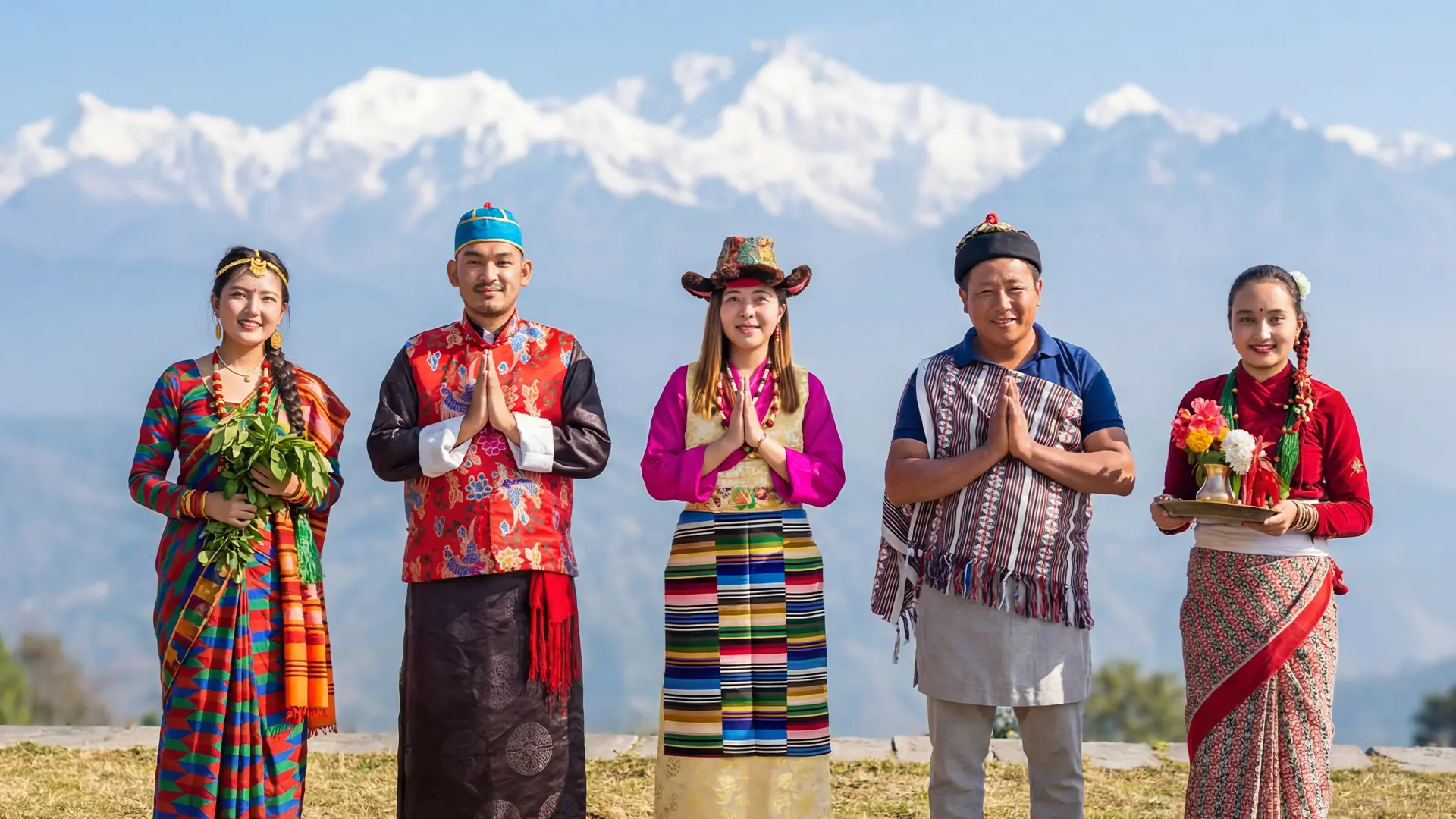
Sikkim stands as India’s Himalayan crown jewel, compact yet commanding, peaceful yet powerful. This northeastern state, though India’s smallest by area, delivers landscapes that range from subtropical forests to alpine deserts, all crowned by Kanchenjunga, the world’s third-highest peak. Prayer flags flutter across mountain passes, monasteries cling to hillsides, and emerald valleys unfold between snow-draped ridges. Whether you seek spiritual solace in ancient gompas, and temples and Mangkhims, adrenaline on high-altitude treks, or simply the soul-cleansing mountain air, Sikkim transforms travelers into storytellers.
Geography and Map of Sikkim
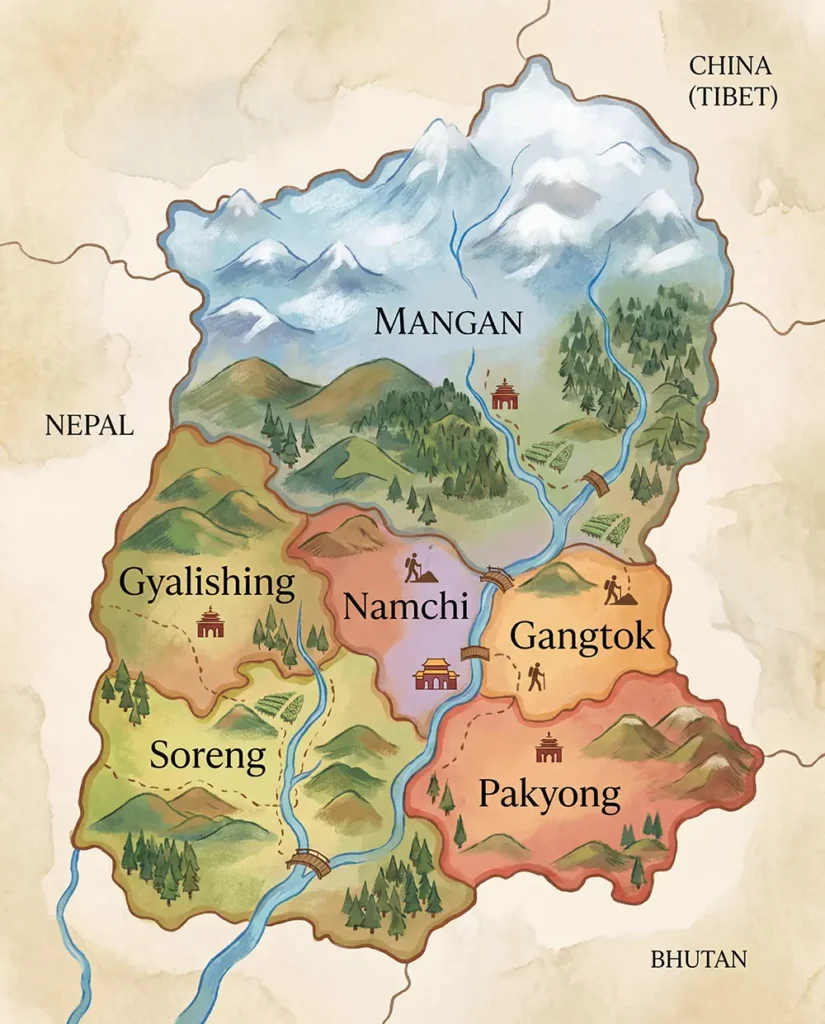
Sikkim’s geography reads like nature’s architectural blueprint. Squeezed between Nepal, Tibet (China), Bhutan, and West Bengal, this 7,096-square-kilometer state showcases dramatic elevation changes—from 280 meters in southern valleys to Kanchenjunga’s 8,586-meter summit.
Six districts organize the state since December 2021: Gangtok, Mangan, Namchi, Gyalshing, Pakyong, and Soreng—expanded from the original four to improve administrative efficiency and local governance.
The Teesta River carves through Sikkim’s heart, sustaining valleys and gorging through Himalayan rock. Western Sikkim, often bypassed by tourists racing northward, harbors pristine wilderness and challenging trek routes. The Singalila Ridge forms a natural boundary with Nepal, while northern plateaus transition into cold high-altitude deserts approaching the Tibetan border.
History of Sikkim
The name “Sikkim” derives from Limboo language—”Su” (new) and “Khyim” (house), meaning “New House.” This etymology reflects the indigenous Limboo people’s ancient connection to this land. In 1642, Phuntsog Namgyal established Sikkim’s Buddhist monarchy at Yuksom, beginning the Chogyal dynasty that ruled for over three centuries.
The kingdom navigated complex relationships with neighbors—particularly the British, who made Sikkim a protectorate in 1861. Following India’s independence, Sikkim remained a protectorate until political movements favoring democracy gained momentum. In April 1975, a referendum resulted in overwhelming support for abolishing the monarchy and joining India. Sikkim became India’s 22nd state in May 1975, fundamentally transforming from independent kingdom to Indian state.
Sikkim Before the Merger
Pre-1975 Sikkim functioned as a theocratic monarchy where Chogyals wielded both political and spiritual authority. The kingdom maintained its own currency, postal system, and international identity, though foreign policy increasingly aligned with India after 1950 treaties.
Political tensions escalated through the 1970s between monarchy supporters and democratic reformers advocating Indian statehood. The Sikkim National Congress championed democratic governance and integration with India, eventually gaining decisive popular support. This political transformation, formalized through the 1975 referendum, ended centuries of monarchical rule and integrated Sikkim into India’s federal democratic framework.
Culture of Sikkim
A Land of Diverse Faiths Sikkim is far more than just a Buddhist haven; it is a kaleidoscope of cultures. The Lepchas and the Tsong (Limboo) are recognized as the original inhabitants (autochthons) of the land. The Lepchas celebrate Namsoong, while the Bhutia community preserves deep-rooted Buddhist traditions.
The state’s vibrant Nepali-speaking population brings a rich mosaic of castes and tribes, including the Rai, Gurung, Sherpa, Newar, and Mangar communities. Together, they celebrate the grandeur of Dusshera and Diwali, the nature-worship of Sakewa, and the winter cheer of Christmas, ensuring the hills are always alive with festivity.
Indigenous Roots Deepening this cultural richness are the specific traditions of Sikkim’s indigenous groups. The Tsong (Limboo) people celebrate their history and harvest through festivals like Bali Hang Tongnam, Chasok Tongnam, and Sirijunga Sawan Tongnam, honoring their distinct ancestry.
The Tamang community adds to the rhythm with their Damphu instruments, while the Sherpas and Bhutias mark Losar with distinct rituals, showcasing a society where every month offers a new reason to celebrate.
Living Heritage & Cuisine Despite these varied origins, the people share a common bond of hospitality and a love for robust Himalayan flavors. The cuisine goes far beyond simple sustenance. Plates are filled with Phagshapa (a spicy pork and radish stew) and crispy Sha Phaley (meat-stuffed bread).
Fermented foods are a staple, from the tang of Gundruk and Sinki to the distinct flavor of Kinema (soybeans). Festivals are sweetened by ring-shaped Sael Roti, while Churpi (hard cheese) and the warm, millet-based Tongba provide comfort against the cold, uniting diverse communities over shared meals.
Communities of Sikkim
Sikkim’s demographic landscape is a complex mosaic of indigenous and settled communities. Both the Lepcha (Rongkup) and Limboo (Tsong) peoples are acknowledged as the state’s original inhabitants. The Lepcha community maintains unique animistic traditions that are deeply interwoven with Buddhist practices. The Bhutia community, tracing their origins to Tibet, introduced Vajrayana Buddhism, a force that has profoundly shaped the spiritual character of the region.
The Limboo (Tsong) community holds ancient roots that predate modern political boundaries. Historically, the distinct identity of the Limboo people was often obscured by their classification within the broader “Nepali” category during colonial and post-independence administrative reorganizations. This classification overlooked their status as original inhabitants comparable to the Lepchas and Bhutias.
The path to official recognition reflects this complexity. While the Constitution (Sikkim) Scheduled Tribes Order of 1978 granted Scheduled Tribe (ST) status to the Bhutias and Lepchas, the Limboo and Tamang communities were initially excluded. It was not until the Constitution (Scheduled Tribes) Order (Second Amendment) Act, 2002 (effective 2003) that this historical oversight was corrected, formally recognizing the Limboo and Tamang communities as Scheduled Tribes.
Beyond these groups, Sikkim’s multicultural society is enriched by the Rai, Gurung, Mangar, and other Nepali-speaking communities, while vibrant Marwari and Bengali populations contribute to the commercial and administrative pulse of urban centers like Gangtok.
Handicrafts of Sikkim
Sikkimese artisans preserve craft traditions merging utility with artistic excellence. Hand-woven carpets featuring Buddhist motifs and geometric patterns demonstrate exceptional skill passed through generations. Thangka paintings—intricate religious scrolls depicting deities and mandalas—require years of apprenticeship to master the precise iconography and natural pigment techniques.
Bamboo craft holds particular cultural significance. Artisans create functional items—baskets, furniture, household implements—alongside decorative pieces. The Khechuperi Bamboo House initiative, established in 2016 by artisan Indra Kari Subba, exemplifies efforts to preserve dying craft traditions. This enterprise produces over 60 types of traditional Sikkimese souvenirs including dhungros (beverage containers), furniture, and decorative items, all crafted through sustainable bamboo harvesting. The workshop trains youth in traditional techniques, promoting bamboo handicrafts as authentic local products against mass-produced imports.
Wood carving transforms walnut, maple, and pine into monastery decorations and choktse tables—low, painted, foldable furniture pieces. Traditional Lepcha weaving produces textiles with geometric patterns using natural dyes. Ritual masks crafted from local Zaru wood represent deities and animals for ceremonial dances, each color and design carrying specific religious significance.
Lakes, Glaciers and Mountains of Sikkim
Kanchenjunga’s 8,586-meter summit dominates Sikkim’s western boundary, forming the state’s most sacred landmark. Other significant peaks include Siniolchu (6,888m), renowned for aesthetic beauty, and Pandim (6,691m) visible from western vantage points.
Tsomgo Lake (3,753m) offers the most accessible high-altitude lake experience, reflecting surrounding peaks in glacial waters that freeze winter solid. Gurudongmar Lake (5,430m) ranks among India’s highest lakes, holding profound religious significance for Buddhists, Sikhs, and Hindus—locals believe one section never freezes despite extreme temperatures. Khecheopalri Lake in West Sikkim carries sacred status for both Buddhists and Hindus, who believe it fulfills wishes; legend claims birds remove any leaf daring to touch its surface.
Samiti Lake (4,200m) on the Goecha La trek displays emerald waters reflecting Kanchenjunga’s south face. Green Lake trek leads to alpine waters beneath the massif’s eastern face, though reaching it demands serious trekking commitment.
Major glaciers include Zemu Glacier—one of India’s largest at 26 kilometers, feeding the Teesta River system—and numerous smaller glaciers sustaining valley ecosystems. Over 227 high-altitude lakes dot Sikkim’s mountainous terrain, creating critical wetland habitats for migratory birds and rare species.
Flora and Fauna
Sikkim’s ecological diversity compresses multiple climatic zones within minimal geographical distance. Over 5,000 flowering plant species thrive across elevation gradients, including 600 orchid varieties painting forests during blooming seasons. Rhododendrons—the state tree—explode in crimson, pink, and white during spring, transforming hillsides into natural gardens.
Alpine meadows transition to bamboo forests, temperate broadleaf woodlands shift to subtropical jungles. This habitat diversity supports remarkable wildlife: red pandas inhabit bamboo thickets, snow leopards patrol high-altitude terrain, and Himalayan black bears roam mid-elevation forests. The Khangchendzonga National Park, a UNESCO World Heritage Site spanning 1,784 square kilometers, protects this biodiversity hotspot.
Bird enthusiasts can spot over 550 species including blood pheasant, Himalayan monal, black-necked cranes wintering in Zemathang plateau wetlands, and numerous high-altitude specialists. Lower elevations harbor barking deer, musk deer, and great Tibetan sheep, while river ecosystems support diverse amphibian and fish populations.
Latest Permit Rules and Regulations
For Indian Nationals:
Indian citizens enter Sikkim without permits but require Protected Area Permits (PAP) for specific regions. North Sikkim beyond certain points (Lachung, Yumthang, Gurudongmar Lake) and parts of East Sikkim (Tsomgo Lake, Nathula Pass, Old Silk Route areas) need PAP obtained through registered tour operators or at police checkpoints.
West Sikkim trekking—particularly Goecha La, Dzongri, Singalila Ridge routes—requires trekking permits from the Forest Department. Apply through registered trekking agencies with fitness certificates for high-altitude routes. Entry permits for Khangchendzonga National Park cost nominal fees plus camping charges, obtained at Yuksom’s Forest Department office. Bring original government-issued photo ID (Aadhaar/Driving License/Voter ID/Passport; PAN cards not accepted), two photocopies, and two passport-size photographs.
For Foreign Nationals:
Foreigners require Restricted Area Permits (RAP), also called Inner Line Permits (ILP), to enter any part of Sikkim. Obtain these at:
- Bagdogra Airport (Sikkim Tourism counter)
- Pakyong Airport near Gangtok
- Rangpo and Melli checkpoints (8 AM-8 PM)
- Sikkim Tourism offices in Siliguri, Delhi, Kolkata
- Online (provisional ILP requiring checkpoint stamp)
RAP remains valid for 15 days, extendable to 30 days at Gangtok’s Foreign Registration Office. Pakistani, Chinese, and Myanmar nationals need Ministry of Home Affairs approval before RAP issuance.
Foreign nationals additionally require PAP for North Sikkim, specific East Sikkim areas, and trekking routes. PAP applications must go through registered Sikkim Tourism operators, requiring minimum groups of two (solo travel not permitted for protected areas). For West Sikkim treks like Goecha La, foreigners need both RAP and trekking permits arranged through licensed agencies.
Always carry permit copies during travel—authorities check regularly at various points. Permits can be revoked without notice due to security concerns or natural disasters, so maintain flexibility in itineraries.
Activities in Sikkim
Beyond conventional sightseeing, Sikkim delivers transformative experiences. Trek the Goecha La route for Kanchenjunga close-ups—this challenging 8-10 day trek through Khangchendzonga National Park takes you via Yuksom, Tsokha, Dzongri, Thangsing, and Samiti Lake to viewpoints offering panoramic Himalayan vistas. Dzongri Top provides 180-degree views of Singalila Range peaks at dawn, while Dzongri serves as an acclimatization point before the final push.
Singalila Ridge trek provides border-spanning views across four countries, following rhododendron-lined trails with possible sightings of Everest, Lhotse, Makalu, and Kanchenjunga. The Dzongri-Goechala traverse combines the best of West Sikkim trekking—alpine meadows, glacial lakes, rhododendron forests, and mountain panoramas that humble the soul.
River rafting on Teesta and Rangit rivers delivers thrills through Himalayan gorges during appropriate seasons. Mountain biking routes descend through terraced villages where homestays offer authentic cultural immersion. Paragliding from Gangtok provides aerial perspectives of valley landscapes.
Monastery visits transcend tourism—opportunities for meditation, learning Buddhist philosophy, and witnessing daily rituals. Rumtek houses the Karmapa’s seat, Pemayangtse displays intricate wooden sculptures, and Tashiding occupies sacred ground between converging rivers. Cable car rides in Gangtok offer leisurely mountain panoramas for those preferring gentler adventures.
Rock climbing and rappelling attract adventure sports enthusiasts to West Sikkim’s rock formations. Yak safaris in Tsomgo Lake area provide traditional high-altitude transport experience. Photography expeditions capture changing mountain light, colorful festivals, and diverse wildlife—though some monasteries restrict photography inside sanctums.
Best Time to Visit Sikkim
Spring (March-May): Peak season when rhododendrons bloom spectacularly and clear skies frame mountain vistas. Temperatures range 15-25°C in Gangtok, ideal for trekking before monsoon rains. April-May particularly suits Goecha La and Dzongri treks as trails dry and rhododendron forests explode in color. Cultural festivals like Saga Dawa occur during this period.
Summer (June-early July): Pleasant weather continues into early monsoon. While late June sees increasing rainfall, the monsoon hasn’t fully established, offering acceptable trekking windows for hardy travelers willing to accept weather uncertainty.
Monsoon (July-September): Heavy rainfall makes travel challenging with frequent landslides and road blockages. Northern regions receive comparatively less rainfall than southern areas—an interesting pattern where southern Sikkim sees maximum monsoon intensity while northern plateaus remain relatively drier. Not recommended for first-time visitors, though valley landscapes achieve maximum lushness and waterfalls cascade dramatically. Hardcore adventure seekers can visit northern areas during this period with proper planning.
Autumn (October-November): Post-monsoon clarity delivers crisp air perfect for high-altitude adventures and photography. Clear skies provide optimal mountain visibility. Temperatures range 10-20°C, comfortable for trekking and sightseeing. This period rivals spring as peak season, offering stable weather patterns and moderate temperatures across elevation zones.
Winter (December-February): Snow transforms higher elevations into pristine wonderlands, enchanting for snow lovers but closing some northern routes. Gangtok and lower altitudes remain accessible with temperatures 5-15°C during day, dropping near freezing at night. Tsomgo Lake freezes solid, Gurudongmar becomes partially frozen, and northern areas experience heavy snowfall potentially isolating regions for weeks. Budget travelers appreciate fewer crowds and lower accommodation rates, though many high-altitude destinations become inaccessible.
For West Sikkim trekking (Goecha La, Dzongri, Singalila Ridge), April-May and October-November provide optimal conditions with stable weather, moderate temperatures, and clear mountain views. Avoid monsoon months for safety—slippery trails, leeches, and landslide risks outweigh any atmospheric benefits.
Sikkim awaits those seeking genuine Himalayan immersion—where landscapes humble, cultures enrich, monasteries inspire, and mountains command respect long after departure.
